Faceless history channel ideas, sourcing, and quality bar
Answer one question per video from real sources. Evidence goes on screen with credits, reconstructions are labeled as reconstructions, and war footage follows YouTube’s ad rules.
By NoFaceTube Editorial Published 7 min read Not yet reviewed by the editor
- Policy risk
- Medium
- Production bar
- Very high
- Formats
-
- Single-question documentary
- Animated map campaign explainer
- Primary-source reading with commentary
- Object or document biography
- One-question explainer Shorts
- Platforms
- YouTube YouTube Shorts TikTok
On this page
History’s raw material sits in archives, much of it reusable once you read the rights statement, and narration over maps and documents is a long-established documentary form. Some of your viewers will have read the books.
This page sets out the bar for a faceless history channel that earns that audience’s trust, the specific ways weak channels give themselves away, and the platform rules that apply to war, death, and reconstructions.
What high quality looks like in history
A strong history video answers a question. “The Hundred Years’ War” is a topic. “How did English kings pay for the Hundred Years’ War?” is a question with an answer you can research, structure, and source. The question gives the video a spine and gives the viewer a reason to stay.
- Accuracy you can trace: every date, name, and number comes from a source you can point to. Battle sizes and death tolls are estimates, so give a range and say whose estimate it is.
- Uncertainty stated plainly: separate what the evidence shows, what historians argue, and what is legend. Say when a chronicle was written decades after the events it describes.
- Research depth beyond the encyclopedia: a recent scholarly overview for the big picture, then the primary sources it cites for the details you quote.
- Period-accurate visuals: the right flags, uniforms, borders, and architecture for the date.
Formats that hold up
Every format here forces original research or original visuals, which is what separates a documentary from a recitation. Style-by-style production notes live in the faceless video styles guide.
- Single-question documentary: one question, answered over a long-form episode, with sources in the description.
- Animated map campaign explainer: movement, terrain, and supply lines drawn as original animated maps, so the cartography makes the case.
- Primary-source reading with commentary: a letter, chronicle, or treaty read closely, with context on who wrote it and why.
- Object or document biography: the life of one artifact, manuscript, or building across centuries.
- One-question explainer Shorts: answer a single question with a map or document shown on screen. TikTok’s Creator Rewards program needs videos of about a minute or more (its support page says “at least” one minute, its launch post “over” a minute) (TikTok), so a history Short meant to earn there is a compact documentary that runs clearly past 60 seconds, not a padded fact.
The production bar
Research and sourcing
Start with a recent scholarly overview, then read the primary sources it relies on. Keep a source log with one line per claim: the claim, the source, the page. That log becomes the description’s source list and protects you when a viewer challenges a detail.
Script
Build the script around the question and let the tension come from real uncertainty, not invented cliffhangers. Quote primary sources briefly and attribute them in the narration. An original angle in history usually means a new lens on a known event: logistics, a different side’s sources, or one overlooked document.
Voice
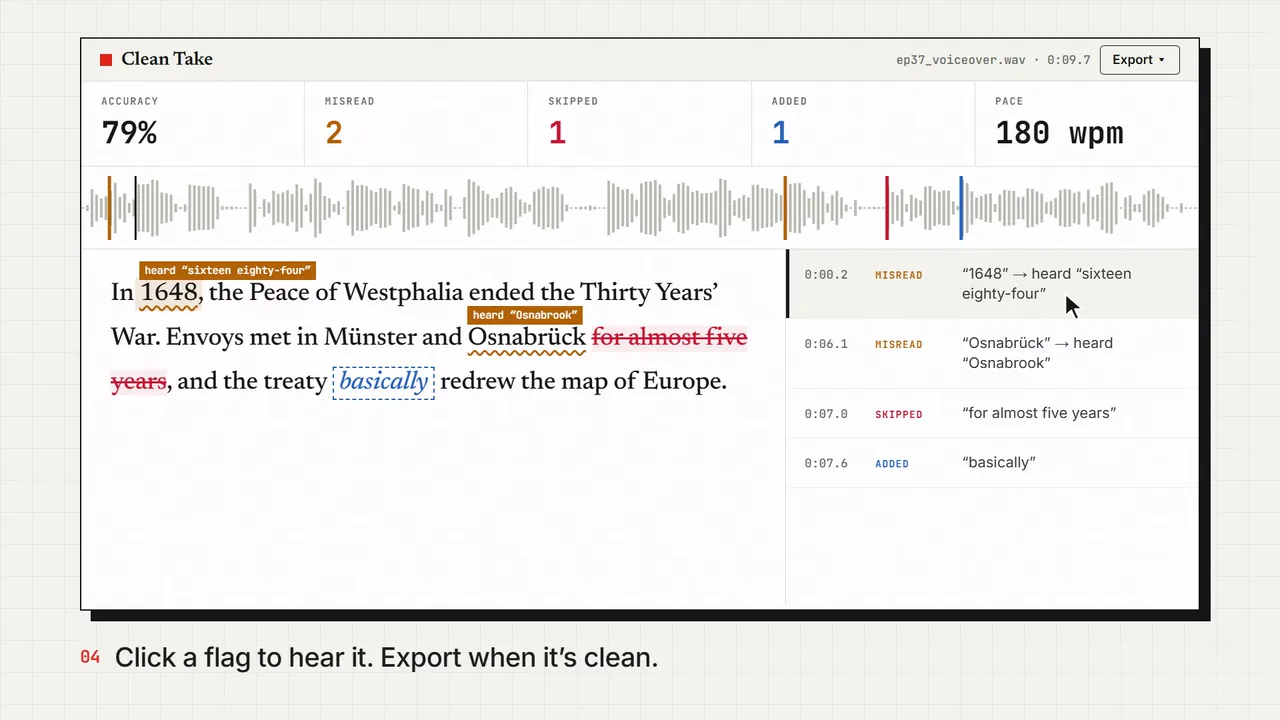
Make a pronunciation list for every name and place before recording, and keep it consistent across episodes. Dates and numbers need slower pacing than the surrounding sentences. Direction and pronunciation control are covered in the AI voiceover guide. A cloned celebrity narrator is off the table. Before you publish, check the take against the script: a swapped year or a misread name is easy to miss once you know the script by heart. Clean Take, our own voiceover checker, flags both.
Visuals
Use maps you made, period images with credits, and documents shown on screen with a citation. Label every reconstruction as a reconstruction, whether it is a painting, a 3D model, or an AI image. Every shot needs a reason, and a slow zoom on a random battle painting is not one.
Sound
Music should follow the structure of the argument, not sit under it as a constant wall of epic score. Map animations need small, specific sound cues. Narration must sit clearly above the music.
Sourcing visuals legally
Old does not mean free. Use the rights statement attached to the copy you download, from the institution that holds it. Treat what follows as a working method for archive material, not legal advice.
- Library of Congress: the Library “generally does not own rights to material in its collections and, therefore, cannot grant or deny permission to publish,” and its Prints and Photographs Division explains that clearing copyright, privacy, publicity, and trademark questions is the user’s job (rights information). Each record carries a rights advisory. “No known restrictions on publication” means the Library knows of no donor restriction and, as far as it can tell, no copyright in effect. Its Free to Use and Reuse sets include public-domain films from the National Film Registry, moving archival footage in which the Library says it is not aware of any U.S. copyright.
- Wikimedia Commons: most files can be reused, but licenses are set per file and each file page states its own requirements (Commons reuse guide). A public-domain tag on Commons can depend on the country, so read the tag, not just the label.
- CC BY-SA: the license requires credit to the creator, a link to the license, and a note if you modified the work. Adapted material you share must carry a compatible license. Under CC BY-SA 4.0, music synced to moving images always counts as an adaptation, so treat BY-SA soundtracks as a licensing decision, not a credit line.
- CC0: a CC0 dedication gives up the uploader’s copyright and nothing more. The legal code leaves trademark rights in place and disclaims responsibility for anyone else’s rights in the work.
- Commercial archives: newsreel and stock archives sell licenses. A clean upload of a newsreel on a video site does not come with one.
Log every asset with its archive, item number, rights advisory, credit line, and when you last checked it. Archival footage also needs real narration and analysis on top of it. That is the Standard’s transformation criterion, and it keeps the channel clear of YouTube’s reused content rule.
Slop tells to avoid
- Generated “photographs” of ancient or medieval events, with extra fingers, garbled banners, and modern faces.
- The same epic score and the same drone shot of ruins under every video.
- “Untold” or “they don’t teach you this” framing for events covered in any textbook.
- A single exact death toll with no source.
- Modern borders on a map of the ancient world, or the wrong flag for the period.
- A king’s name said one way in episode three and another way in episode nine.
- An encyclopedia article paraphrased in the same order, with no sources in the description.
- Public-domain battle paintings in a slow-zoom slideshow under a flat synthetic voice. Image slideshows are one of YouTube’s named examples of generic or repetitive content, which is excluded from monetization (monetization policies).
- A synthetic voice of a historical figure reading words they never said.
Policy and advertiser-suitability risks
History carries medium policy risk. Most history is safe, but war, atrocity, and extremist movements are central subjects, and the rules there are detailed. We checked the guidelines quoted here on 5 October 2026. YouTube logs changes on its ad guideline updates page, which notes an August 2026 clarification of how depictions of death are treated in educational, documentary, and news content.
Ad suitability. The advertiser-friendly content guidelines draw the lines a history channel needs:
| Ad outcome | What YouTube lists |
|---|---|
| Can earn ads | Non-graphic educational coverage of war; dead bodies “fully obscured, blurred, prepared for burial, or shown in historical events like wars, as part of an educational video” |
| Limited ads | Dead bodies with obvious injury “in educational or documentary settings (such as a history learning channel)”; raw, non-graphic footage of armed conflict without educational context |
| No ads | ”Footage of war with graphic depictions of injury, death, or suffering in any context”; graphic images or accounts of shootings, explosions, executions, or bombings |
Thumbnails count. A graphic thumbnail can limit ads on an otherwise careful video.
Community Guidelines. YouTube may allow violent or graphic material in educational or documentary content, but the context “must appear in the images or audio of the video itself,” so a title or description that explains the footage is not enough (violent or graphic content policies, EDSA). The hate speech policy lists “historical footage of an event, like WWII, which doesn’t promote violence or hatred” as allowed. Narrate the context clearly whenever extremist imagery is on screen.
Reconstructions. A photorealistic AI shot of a real siege is exactly what YouTube’s synthetic content rule targets: it requires disclosure when realistic content makes a real person appear to say or do something they did not, or generates a realistic scene that did not occur (YouTube Help, YouTube Blog). The AI disclosure guide and the disclosure rule entry cover how to label it. YouTube’s July 2026 guidance also names realistic visuals that trick viewers into believing a fake disaster happened as content that cannot be monetized (monetization policies, TechCrunch).
Channel ideas worth making
- The campaign told through its supply lines: logistics turns a familiar battle into a new story with its own evidence: roads, rations, and distances.
- One document, read closely: a single letter, tax roll, or treaty read line by line, so the viewer hears the period in its own words instead of over a stock montage.
- How we know: spend the video on the evidence for a famous event: which sources survive, who wrote them, and how long after. The viewer leaves with a way to judge the evidence.
- The myth’s biography: trace when a popular story about an event first appears in print and how it spread, from one dated source to the next.
- One place, redrawn: a single region mapped across centuries in original animation, so the shifting borders tell the story.
- The losing side’s record: tell a well-known conflict from the surviving sources of the side that lost.
- Historians disagree. Lay out two scholarly interpretations and the evidence each relies on, without picking a side for drama.
Sources
- 1Advertiser-friendly content guidelinesYouTube Help
- 2Upcoming and recent ad guideline updatesYouTube Help
- 3Violent or graphic content policiesYouTube Help
- 4How YouTube evaluates educational, documentary, scientific, and artistic (EDSA) contentYouTube Help
- 5Hate speech policyYouTube Help
- 6Disclosing use of GenAI contentYouTube Help
- 7How we’re helping creators disclose altered or synthetic contentYouTube Official Blog · 2024-03-18
- 8YouTube channel monetization policiesYouTube Help
- 9YouTube clarifies policies around AI slop and upsetting videosTechCrunch · 2026-07-20
- 10Copyright and Rights and Restrictions InformationLibrary of Congress
- 11Public Domain Films from the National Film RegistryLibrary of Congress
- 12Commons: Reusing content outside WikimediaWikimedia Commons
- 13Attribution-ShareAlike 4.0 International (CC BY-SA 4.0)Creative Commons
- 14CC0 1.0 Universal legal codeCreative Commons
- 15TikTok Creator Rewards ProgramTikTok Creator Academy
Spotted an error or a dead source link? Send a correction.