Is faceless YouTube dead? What changed in 2025–2026
No. The template version is being pushed out on purpose, through policy and public enforcement. Faceless channels built on research, direction, and an original angle are not what the rules describe.
By NoFaceTube Editorial Published 8 min read Not yet reviewed by the editor
On this page
Faceless YouTube is not dead. One way of running a faceless channel is: generated scripts, stock or AI visuals, a default synthetic voice, many uploads a week, and little human judgment anywhere in the chain. YouTube spent 2025 and 2026 sharpening its rules against that model and enforcing them in public. The rules say nothing about faces.
This page sets out what changed, what didn’t, who is exposed, and what “high quality” means when you are the one making the videos. It makes no promises about earnings.
The short answer
- Being pushed out: templated, mass-produced channels whose videos are interchangeable. YouTube says this content was never eligible for monetization, and it is now enforcing that more visibly.
- Not the target: faceless channels where each video has a researched script, a point of view, and visuals and sound chosen on purpose.
- A risk for everyone: enforcement is partly automated, and automated systems make mistakes. Good channels need records of their process.
What changed
July 2025: the rule got a sharper name
YouTube renamed its “repetitious content” monetization rule to “inauthentic content” and clarified that it covers mass-produced videos (TechCrunch). YouTube called it a minor update to a long-standing rule. The coverage called it an AI crackdown, and the “is it dead?” question started here. Our inauthentic content guide explains the rule in full.
Late 2025: someone measured the problem
Kapwing, a video-editing company, looked at the top 100 channels in each country, about 15,000 channels in all, and classified 278 of them as AI slop channels (MediaNama, The Daily Dot). It also reported that 104 of the first 500 Shorts recommended to a new account, roughly one in five, fell into its AI slop category. These are Kapwing’s own classifications, not YouTube’s figures, but the study was widely covered and it named channels.
January 2026: YouTube removed some of the largest AI channels
By late January 2026, Kapwing counted 16 channels from its list removed or emptied, with about 4.7 billion lifetime views between them (Android Headlines, Dexerto). Tubefilter, citing Kapwing, says at least 18 (Tubefilter). A YouTube spokesperson said the platform does not allow spam, scams, or other deceptive practices. See the tracker entry on the removals.
January 2026: the CEO named AI slop a priority
In his annual letter, CEO Neal Mohan said the rise of AI had raised concerns about low-quality content, and that YouTube is building on the systems it uses against spam and clickbait to reduce the spread of low-quality, repetitive content (YouTube Blog). CNBC summarized it as “managing AI slop” being a 2026 priority (CNBC). The same letter promoted YouTube’s own AI creation tools. The line it draws is between AI as a tool and AI as a substitute for effort.
May 2026: AI labels moved into view
YouTube moved AI disclosure labels to a more visible position, below the player on long-form videos and on the video itself for Shorts, and began applying the label automatically when a creator does not answer the disclosure question and its systems detect significant photorealistic AI use (YouTube Blog). Disclosure is a separate rule from monetization. Our AI disclosure guide covers it.
July 2026: the rule was spelled out
YouTube split inauthentic content into three named categories: generic or repetitive content, unsatisfying or off-putting content, and AI-generated personas presented as human experts giving advice on health, finance, legal issues, or politics (Tubefilter). It described this as a clarification, not a new rule. See the tracker entry.
Other platforms moved in the same direction
- Meta, July 2025: Facebook accounts that repeatedly reuse other people’s videos, photos, or text lose access to monetization and get reduced distribution on everything they share (TechCrunch). Tracker: Meta’s unoriginal content crackdown.
- TikTok, November 2025: TikTok announced a test of a Manage Topics control that lets viewers turn down how much AI-generated content they see in For You (TechCrunch). Tracker: TikTok’s AI content controls.
- TikTok Creator Rewards pays only for original videos “over a minute” long, in the words of its March 2024 launch announcement (TikTok), from accounts that meet follower and view thresholds. Tracker: Creator Rewards requirements.
What did not change
- No rule requires a face. YouTube’s monetization policies are written around templates, repetition, reuse, and added value.
- AI tools are allowed. YouTube’s VP of Trust and Safety said the company is “agnostic” about which tools creators use (Engadget).
- Recurring formats are allowed. The policy explicitly permits the same intro and outro on every video, and series with a fixed structure, when the substance of each video differs.
- Narration is allowed, human or synthetic. Disclosure rules turn on realism and real people, not on whether a narrator is synthetic.
- The review is still about the channel. Reviewers look at a channel’s theme, most-viewed videos, and newest videos, not a single upload.
Who is exposed
These are our readings of the published rules applied to common faceless models, not YouTube rulings.
| Channel model | Why it is exposed | Rule it runs into |
|---|---|---|
| Daily stock-footage list videos with generated scripts | Each video is interchangeable with the last | Generic or repetitive content |
| AI slideshow stories with a default voice | Slideshows with minimal or no narrative are a listed example | Generic or repetitive content |
| Forum-post readings over borrowed gameplay | Readings of others’ material, plus footage you didn’t make | Inauthentic content and reused content |
| Clip compilations from other platforms | Little or no narrative or commentary | Reused content |
| AI shock clips: animals in danger, fake disasters | Built to shock rather than to tell a story | Unsatisfying or off-putting content |
| AI “doctor” or “financial adviser” presenters | A synthetic persona on a sensitive topic | AI personas on sensitive topics |
| Networks of channels run from one template | Every channel is the same template | Generic or repetitive content |
YouTube’s policies also say monetization can be suspended or disabled on any or all of a creator’s accounts. Starting a fresh channel on the same template moves the problem without solving it.
Who is not the target
A faceless channel where each video is a distinct piece of work. In practice that looks like:
- a history channel where each episode answers one specific question, with sources and original maps;
- a science and space channel with motion graphics built for the explanation, not pulled from a stock library;
- a mythology channel that retells primary texts with a clear point of view and commissioned or carefully directed art;
- a business stories channel built on documented sources, filings, and interviews in the public record.
These are descriptions, not channels. Real exemplars live in the Channel Index, curated by a person who has watched them.
A quick test: which side of the line are you on?
Three questions sort most channels faster than any checklist.
- Could someone else produce your next video from your last one? If a freelancer could swap the topic in your script, re-run the same prompts, and publish something indistinguishable, the channel is a template. If they would need your research, your angle, and your edit decisions, it is not.
- What happens when you cut volume in half? A template channel has nothing to spend the extra time on. A production channel spends it on research, direction, and sound, and the videos get better.
- Who made the decisions? List the creative decisions in your last video: the angle, the structure, the shots, the music, the pacing. If a generator made most of them, the video belongs to the tool, and so does every other channel using the same tool. If you made them and the tools carried them out, the work is yours.
None of these questions mentions a face, and none of them mentions AI as a problem in itself. That matches how the rules are written.
The risk good channels still carry
In late July 2026, the animated science channel Kurzgesagt said YouTube’s automated systems had treated one of its hand-animated videos as low-quality AI content and limited its recommendations, despite strong viewer metrics. YouTube reportedly helped resolve it (Kotaku, Dexerto).
Three lessons for faceless creators:
- A clean look is not a defense. A calm narrator over tidy explanatory graphics is also what cheap channels imitate. Distinctiveness lives in the angle, the research, and the choices, not the surface style.
- Keep process records. Research notes, script drafts, project files, and licenses are what you show if a review or appeal asks how a video was made.
- Know the appeal deadlines before you need them. Our policy guide lists them.
What “high quality” means in practice
The Standard breaks “high quality” into eight choices you can check:
- Original angle: each video answers a question the top results do not, or answers it better with evidence.
- Researched script: every claim has a source; dates, names, and places are specific.
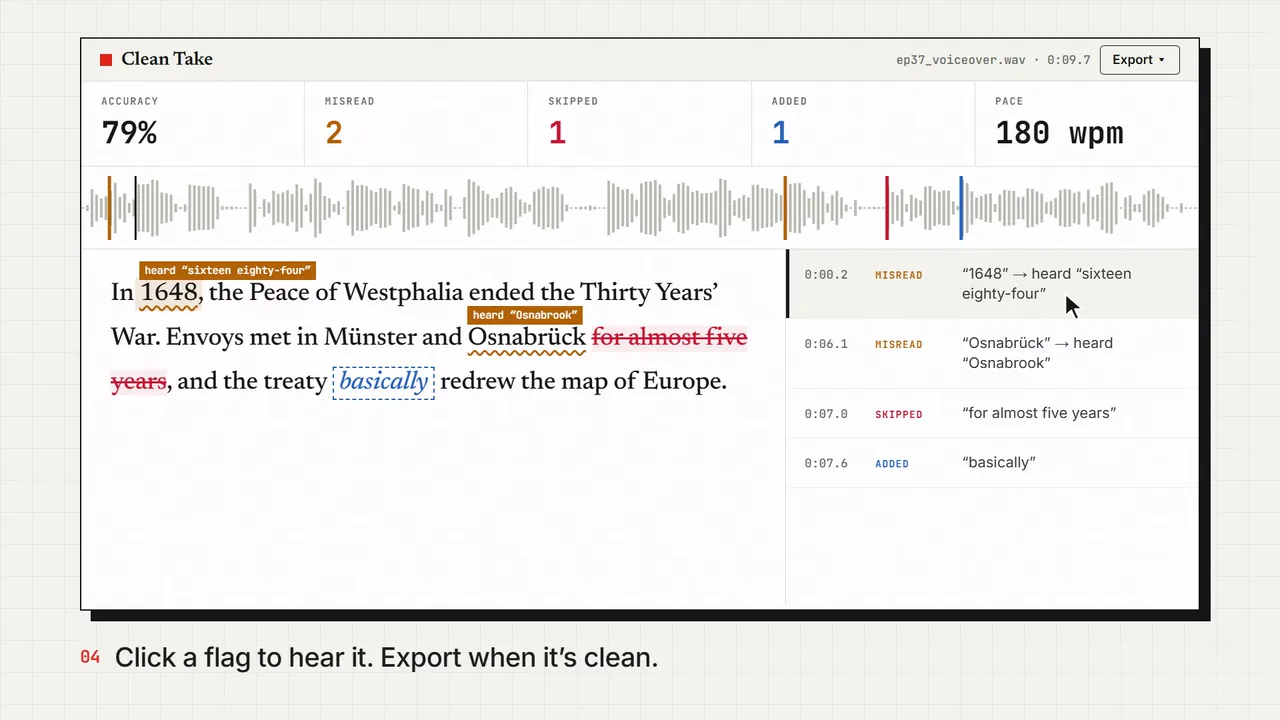
- Directed voice: human or synthetic, the performance is directed line by line and names are pronounced correctly. See AI voiceover quality.
- Intentional visuals: each shot is chosen for what the script means, and custom graphics fill the gaps stock cannot.
- Sound design: layered sound, with music chosen per video rather than one loop for the channel.
- Edit rhythm: pacing follows the argument, not a fixed cut interval.
- Transformation of reused material: borrowed material carries commentary, analysis, or a storyline.
- Disclosure and compliance: realistic synthetic content is labeled where platforms require it.
Each video costs more time, so you make fewer of them. Template channels cannot absorb that cost, which is why the same bar protects the channels that clear it. Our guide to faceless video styles shows which formats hold up under that cost.
If you run a template channel today
- Audit it honestly. Use the self-audit in our policy guide on your most-viewed and newest videos.
- Cut volume first. Fewer uploads buy the time each video needs.
- Narrow the angle. “Facts about space” is a template. “How each Mars mission chose its landing site” is a series.
- Rebuild one stage at a time. Script and research first, then voice direction, then visuals and sound.
- Disclose where required. Check AI disclosure rules for each platform you post to.
- Follow the rules as they move. The Rules tracker records each change with sources and a last-verified date.
Sources
- 1YouTube channel monetization policiesYouTube Help
- 2YouTube prepares crackdown on “mass-produced” and “repetitive” videos, as concern over AI slop growsTechCrunch · 2025-07-09
- 3AI slop videos make up 33% of YouTube feed, says studyMediaNama · 2025-12
- 4“Make it stop”: A new study says 20% of YouTube videos are low-quality AI slopThe Daily Dot
- 5YouTube wiped AI slop, erasing 4.7 billion views from low-quality contentAndroid Headlines · 2026-01
- 6YouTube responds after deleting popular “AI slop” channels with millions of subscribersDexerto · 2026
- 7YouTube has banned some slop channels. Can it stay ahead of “low quality AI content”?Tubefilter · 2026-01-29
- 8YouTube CEO Neal Mohan’s 2026 letter: The future of YouTubeYouTube Blog · 2026-01-21
- 9YouTube chief says “managing AI slop” is a priority for 2026CNBC · 2026-01-21
- 10Improving AI labels for viewers and creatorsYouTube Blog · 2026-05-27
- 11YouTube clarifies that creators can’t monetize “generic or repetitive content,” content that’s “unsatisfying or off-putting,” or content with fake AI “experts”Tubefilter · 2026-07-13
- 12YouTube explains its AI slop policy and why some creators won’t get paidEngadget · 2026-07
- 13Following YouTube, Meta announces crackdown on unoriginal Facebook contentTechCrunch · 2025-07-14
- 14TikTok will let you choose how much AI-generated content you want to seeTechCrunch · 2025-11-18
- 15Introducing the New Creator Rewards ProgramTikTok Newsroom · 2024-03-18
- 16YouTube Mistakes Popular Science Channel For AI SlopKotaku
- 17YouTube’s AI slop detector incorrectly targets Kurzgesagt as other creators fear same fateDexerto
Spotted an error or a dead source link? Send a correction.